






| SIGN UPS ARE OPEN! Grab here one of the forty places now! | NEWSLETTER | ||||||
|
FE.IV Research, teaching and digital innovation 14 - 18 September |
|||||||
| Organized by: | |||||||
 |
|||||||
| 1· Overview |
| Where the pressure has landed |
|
Universities have rarely been asked to change so much about the way they teach, and rarely had so little time set aside to think about it. Three transformations arrived within a few years of one another, and none of them waited for a curriculum reform. The first is data. Research now produces evidence in volumes and formats that no lecture was built to carry: instrument streams, image collections, simulation outputs, datasets that exist in more versions than anyone has counted. Europe answered with the FAIR principles — findable, accessible, interoperable, reusable — and in most institutions FAIR has been received as a compliance obligation bolted onto the end of a project. It is that. It is also something said far less often: the precondition for a research result to be teachable at all. A dataset that cannot be found, opened and understood by someone who was not in the laboratory can be taught by exactly one person, its author, and only for as long as they remember it. The second is artificial intelligence, which entered the lecture hall before any university had decided what it was for. Students brought it in; teaching staff followed; the institutional response is still, in many places, a document about academic misconduct. Meanwhile the technology has moved from generating text to carrying out tasks — retrieving, planning, drafting, assessing. The useful questions are no longer whether to permit it, but narrower and harder ones: what a model actually does to a scientific document, where the sources went, and who is answerable when a machine drafts a syllabus, marks an exercise, or answers a student at two in the morning. The third is recognition. A degree certifies a moment. A competence has to stay current across decades of working life, and the system Europe is building around micro-credentials and interoperable badges is an attempt to make that visible. It works on one condition: that the badge carries the evidence behind it. Otherwise it certifies attendance, which every institution already knows how to do. None of the three belongs to a single discipline, and none is settled by adding a course to a curriculum or running a refresher session on tools. They converge on one practical operation that universities perform badly, because almost nobody is trained to perform it: turning a research object into a learning object. |
| ALM@ — the network behind the Camp |
|
That operation is what ALM@ exists to make routine. The Advanced Learning Multimedia Alliance for Inclusive Academic Innovation is a Digital Education Hub funded by the European Union — NextGenerationEU under the Italian National Recovery and Resilience Plan, Mission 4 Component 1, Investment 3.4 on advanced university teaching and skills, Digital Education Hubs sub-investment (ID DEH2023-00012, CUP E68H24000430006). It brings together thirteen Italian public universities and one higher education institution in art and music, with nine associated partners, coordinated by the University of Naples Federico II through its Federica Web Learning centre. Sapienza University of Rome is a partner of the Hub, and that is where this Featured Event comes from. The purpose of the Hub is to gather Italian university and academic teaching into a single digital space, and to make it accessible anywhere and to anyone: modular, free of charge and of high quality — learning conceived as something that accompanies a person through the phases of a life rather than the years of an enrolment. Its catalogue is deliberately plural in format: MOOCs and webinars, master programmes and workshops, remote laboratories, podcasts, smart guides, entire degree programmes. Five principles hold the network together, and each of them leaves a visible mark on the design of the Camp.
|
| 2 · How the Digital Forge Camp 2026 is structured |
| The Camp unfolds in distinct moments across the week of NanoInnovation. Digital Forge Camp 2026 is the Featured Event as a whole: an opening session and a round table inside the Sapienza PNRR Forum on Monday 14, a two-day school — The Learning Shift — on Wednesday 16 and Thursday 17, and a demonstration room open to every visitor on Friday 18. All activities take place at the Faculty of Civil and Industrial Engineering of Sapienza University of Rome. |
| MONDAY 14 SEPTEMBER |
| Session I of the Sapienza PNRR Forum |
| The Digital Forge Camp opens inside the Sapienza PNRR Forum, whose first afternoon session is given over to innovation in teaching and learning. Two talks set the frame: what the availability of open, documented research data changes in the way a discipline is taught, and what artificial intelligence is already doing to the work of designing, delivering and assessing a course. Between them they establish the vocabulary the rest of the week uses — FAIR data, learning objects, micro-credentials — and the reason the three pressures are treated together rather than as three separate policy files. Titles, speakers and exact times are confirmed in the final programme. |
THE ROUND TABLE |
| The talks are followed by a round table moderated by a science journalist, with a panel drawn from universities, research bodies, industry and public institutions. The discussion moves across artificial intelligence in education, the skills the labour market is already asking for, the digital university and lifelong learning, the relationship between universities and industry, Open Badges and open education — all of it within the wider question of innovation and the demands it places on the way people are trained. Because it carries the strand on innovation in teaching, the round table belongs to the programme of the Digital Forge Camp, and closes its opening day. It begins at about 18:00 in the Chiostro. |
| WEDNESDAY 16 and THURSDAY 17 SEPTEMBER · THE SCHOOL |
| THE LEARNING SHIFT A Digital Forge Camp for Learning and Teaching Innovation |
| SYNOPSIS |
|
Innovation in university teaching is the point where three transformations, so far separate, converge: the availability of open, documented research data; the spread of artificial intelligence tools in the hands of teachers and students alike; and the European and national demand for competences that can be certified and updated over an entire working life. None of the three concerns a single discipline, and none of the three is settled by a refresher course on tools. Addressed first of all to doctoral candidates and early-career researchers, The Learning Shift starts from a precise challenge: those who produce new knowledge must also be able to make it learnable, verifiable, accessible and transferable. This community occupies a decisive position between research, teaching and the professions: today it contributes to producing knowledge; tomorrow it will be called upon to teach it, communicate it, assess it and turn it into competences. The Digital Forge Camp format turns this challenge into an intensive, collaborative environment. Over four half-days, data, papers, protocols, cases and research questions become material for designing learning experiences. Vision talks, demonstrations and cross-disciplinary exchange take participants from the research object to the learning object, up to the definition of observable and recognisable results. The school explores how open data, documented according to the FAIR principles (findable, accessible, interoperable, reusable), can feed new teaching practices; how AI can support design, tutoring, feedback and assessment while keeping responsibilities and choices visible; and how micro-credentials and other forms of certification can make competences legible and open to updating. It is the FAIR principles that make a research object reusable by those who did not produce it: the technical condition of the passage to the learning object. Methods, languages, technologies, accessibility and participation are treated as parts of the same ecosystem. The Learning Shift creates a space in which experiences born in different disciplines meet, cross-fertilise and become shared heritage. A shift from individual practice to the collective capacity to innovate university teaching, preparing a new generation of researchers able to produce knowledge and put it into circulation. |
| THE TRAJECTORY From the research object to the learning object — from evidence to competence. |
|
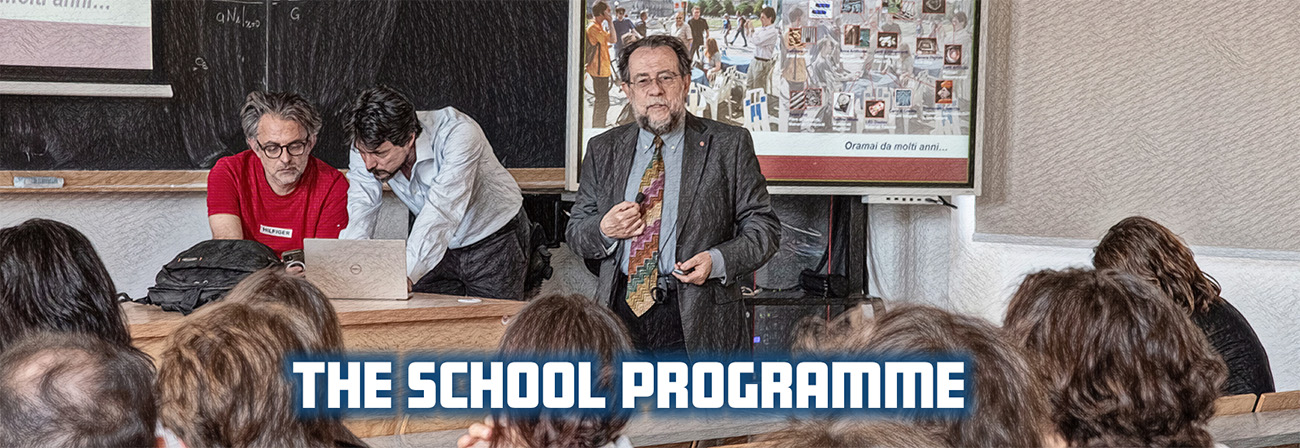
Four half-days, eight blocks of ninety minutes, sixteen lessons of forty-five minutes. Forty places, free of charge, assigned through public selection on the basis of curriculum, motivation and coherence of the applicant’s path. No age requirement operates as an exclusion — earlier career stages are given priority — and the selection attends to gender balance, to the plurality of institutions represented and to participation from the regions of southern Italy. The progression is deliberate. It starts from what can be seen working — two demonstrators and the discipline that feeds them; it goes back to the methodological foundation that makes them possible, the FAIR data object; it moves on artificial intelligence, from the way a model is built to what it does in a classroom; and it closes with the conditions that make a result learnable and recognisable: immersive environments, quality, accessibility and certification. Three threads run across the modules rather than occupying a slot of their own: the FAIR condition that makes a research object reusable, the accessibility of what is produced, and the recognition of competence — micro-credentials, Open Badges and the evidence that has to sit behind them. The lesson abstracts, published with the final programme, indicate where each of them is addressed. |
 |
| WEDNESDAY 16 TO FRIDAY 18 SEPTEMBER |
THE PLAYGROUND ROOM |
|
The classroom and the exhibition space are the same room, equipped once for the whole week. Two playgrounds, each assembled on two workstations: four staffed positions in all. During the two days of the school the room is a classroom, and the workstations are open during the long morning break and staffed through the other breaks. On Friday 18 the room is given over entirely to the playgrounds and opens to all NanoInnovation visitors; the opening hours of the public day are confirmed in the final programme. The scientific content and the datasets are contributed by the teaching staff and by the research groups involved. What is demonstrated is real work. Playground 1 · RITA: an AI study companion grounded in the course materials As a complement to the lessons, two workstations are given over to RITA — Ripassa In Tutta Autonomia, “revise independently” — an educational chatbot built on retrieval-augmented generation (RAG) and developed within the ALM@ project (PNRR Mission 4). The workstations will be configured with teaching materials from courses in Sapienza’s Master’s degree programme in Aerospace Engineering, allowing participants to interact with the system just as they would in their own studies: asking questions about course content and receiving accurate answers grounded in the instructor’s materials, requesting the generation of exercises with correct data and being guided step by step through solving them without the solution being revealed, and uploading their own work to get feedback and correction suggestions. Unlike general-purpose chatbots, RITA answers exclusively on the basis of the teaching materials provided by the instructor, reducing the risk of hallucinations and ensuring consistency with the course syllabus. The goal is to give participants hands-on experience of what a personalised virtual assistant can do when it is available at any hour and integrated directly into the university’s Moodle platform. Playground 2 · VM2026: CAD and CFD simulation as a learning environment A further two workstations give access to the VM2026 platform, in guided sessions with the pre-installed simulation software. The available software includes: ANSA, a CAE pre-processor for preparing geometric models and generating high-performance meshes; CFD++, a computational fluid dynamics solver for compressible, incompressible, turbulent and reactive flows; Tecplot 360 EX, post-processing and graphical visualisation software for simulation results; Nastran and Patran, respectively a solver and a pre/post-processing environment for finite element structural analysis; and MATLAB and Simulink, for numerical computation and dynamic system simulation. A number of features and tools have been implemented within the platform to make the use of the various software packages more accessible to all users. |
3 · Access, registration and information |
Access and registration |
| Attendance at the round table and at the open demonstration day follows the general rule of NanoInnovation 2026 — free of charge, upon online registration on this website. Admission to the school is regulated by the selection procedure set out below. On Wednesday and Thursday the demonstration workstations are part of the school; on Friday the room is open to every registered visitor of NanoInnovation. Lessons are delivered in English. Participants with specific accessibility requirements can state them in the application form; the materials produced by the school are released in accessible formats. |
Applying to the school |
| Participation is free of charge and limited to forty places, assigned by selection. Applications are submitted exclusively through the online form, available from Monday 24 August 2026 at this LINK. The form asks for a short profile — affiliation, position, disciplinary field — and a few lines on the reasons for applying. No previous training in teaching is required: the lessons are introductory in register and substantial in content. Submitting an application does not guarantee admission: selected applicants will be asked to confirm their place and to complete the general NanoInnovation registration. Enquiries: |
| Selection |
|
Selection runs in two stages. Applications received by Tuesday 1 September 2026 are examined together at the close of that window: the assessment weighs the fit between the applicant’s profile and the themes of the school, the reasons given, and the aim of composing a group that is mixed by discipline and by institution. Outcomes are communicated by email by Thursday 3 September. On any places still free, applications remain open and are examined as they arrive, with an answer within a few days; where the fit is equal, order of arrival decides. Applications close when the forty places are filled, and in any case no later than Thursday 10 September 2026. |
Recording and certification |
|
The lessons are recorded, with the consent of speakers and participants, for possible post-production and inclusion in the ALM@ catalogue; the materials are released under an open licence. Participants who attend at least three of the four half-days receive a certificate of attendance and an interoperable Open Badge issued within the ALM@ framework. Consistently with the principle set out at the opening of this document — a badge is worth what the evidence behind it is worth — the badge records both attendance and the work produced during the school. |
Funding |
| ALM@ — Advanced Learning Multimedia Alliance for Inclusive Academic Innovation — is funded by the European Union — NextGenerationEU under the Italian National Recovery and Resilience Plan, Mission 4 Component 1, Investment 3.4, Digital Education Hubs sub-investment (ID DEH2023-00012, CUP E68H24000430006). |